Showing posts with label Brownsville PA. Show all posts

Wednesday, June 6, 2012

Snowdown and Sons: Field Pictures.

Hello Everyone,

 Things have been running on overdrive at the Snowdon Site! We are in the process of completing our first field season there at the end of this week, although it looks like we may be there next week as well. We've made a startling discovery as well, that I will elaborate on in my next post. For now, here are some great photos of this past week's field work. Enjoy!


Julz and Kyle

Outside North Foundation Wall

N116-120 E100-108 Excavation Block

Volunteer Chaze Excavating around the remains of puddled iron

Kyle holding the remains of a leather sack! (We also have the contents!)

Carl Mapping a portion of the exterior North Foundation.
    

Sunday, November 20, 2011

Some free tools for Archaeologists

Hello Everyone,


     I have recently been noticing on the social network channels (Google+, Facebook, Twitter) a lot of people integrating the Ipad and its software suite for many applications for archaeologists. I cannot agree more that this piece of hardware could be VERY useful in the field. It might even be more so, once a Topcon Total Station can be integrated (if it's not already possible).
     However, not every archaeologist or archaeology club has the resources to go out an buy an Ipad or a smart phone for that matter. Not many individuals have the $1,000 for Photoshop or Illustrator, let alone for the expense of Autodesk CAD or Arcview GIS. What about us little archaeology guys and gals who want functionality on the cheap for digitizing maps or using a GIS (Graphic Information Systems) program to help us out? This is your day! I'm going to lay a few great programs for those of us on a budget.


Operating Systems:


English: A screenshot of Ubuntu 11.04 (Natty N...
Image via Wikipedia
Ubuntu Linux- A great open sourced operating system that combines the simplicity of using apps like an Ipad and the stability of Apple. Of special note is the way a user installs and uninstalls applications. Ubuntu has an app store with hundreds of free open sourced programs that are simply installed and uninstalled like an app for Android or IOS. Many of the programs I'll talk about are in that app store for free! Plus its easy to use Unity interface is clean and streamlined. The whole operating system can be downloaded and installed onto a thumb drive and placed on a netbook.  
http://www.ubuntu.com/


English: AROS Research Operating System screen...
Image via Wikipedia
AROS- A lightweight fast operating system based on the Amiga OS. It is clean, fast, and has a great user support community. This operating system is for those of you who just need a dependable, fast OS for web surfing and using Google Docks for most of your work. Right now there are a limited number of ports for AROS on the research end of things, however, if you have an old machine that cannot run Windows Vista, or Windows 7, AROS can breathe some new life into it!
It's perfect for an archaeologist on a very tight budget looking for a web machine for researching projectile points!
http://aros.sourceforge.net/


Drawing Programs:


Wikipedia
Inkscape- A free vector graphics drawing program.This program is like iDraw only free, and you don't need a Mac or Ipad to use it. This program has a great feature set, and is an excellent replacement for Adobe Illustrator. It will import files directly from Auto CAD (.dxf files), pdfs, Corel, Word Perfect, the list goes on! This program is great for digitizing field maps, plan views, feature profiles, etc. I've posted an image here of a feature I drew. (Mac, Windows, Linux)
http://inkscape.org


Wikipedia
Paint.NET- A free drawing program with many of the great feature of Adobe Photoshop without the cost. Is this Photoshop? Well, no. It is not going have feature for feature what Photoshop has, but for the archaeologist on a budget, it does amazing work. There are layers and layer controls and the ability to save in a variety of Tiff, Jpeg, and Png files. There is also an incredible library of plugins to extend Paint.NET's capability.  If you are looking for something that has many of the great features of Photoshop, this program is easy to use, and easy to navigate, and expandable. (Windows only!)
http://www.getpaint.net/


GIS: Graphic Information Systems


GRASS 6.3
Image via Wikipedia


Grass GIS - This is a  powerful system and fully capable to today's standards for GIS applications. Grass works with 2d and 3d maps and images. Grass GIS has been in development for over 20 years and used throughout the government and its agencies for spatial analysis. This software is compatible with Arcview GIS formats. (Windows, Linux, Mac)  
http://grass.osgeo.org/


Wikipedia
QGIS (Quantum GIS)- a GIS system with an easy to use graphical user interface. As my friend Matt pointed out on Google+, QGIS' "strengths are in its graphical orientation were as GRASS is better at analysis and processing". QGIS can run inside or a GRASS shell bring extended features into the QGIS system.  (Windows, Linux, Mac)
http://www.qgis.org/


Wikipedia
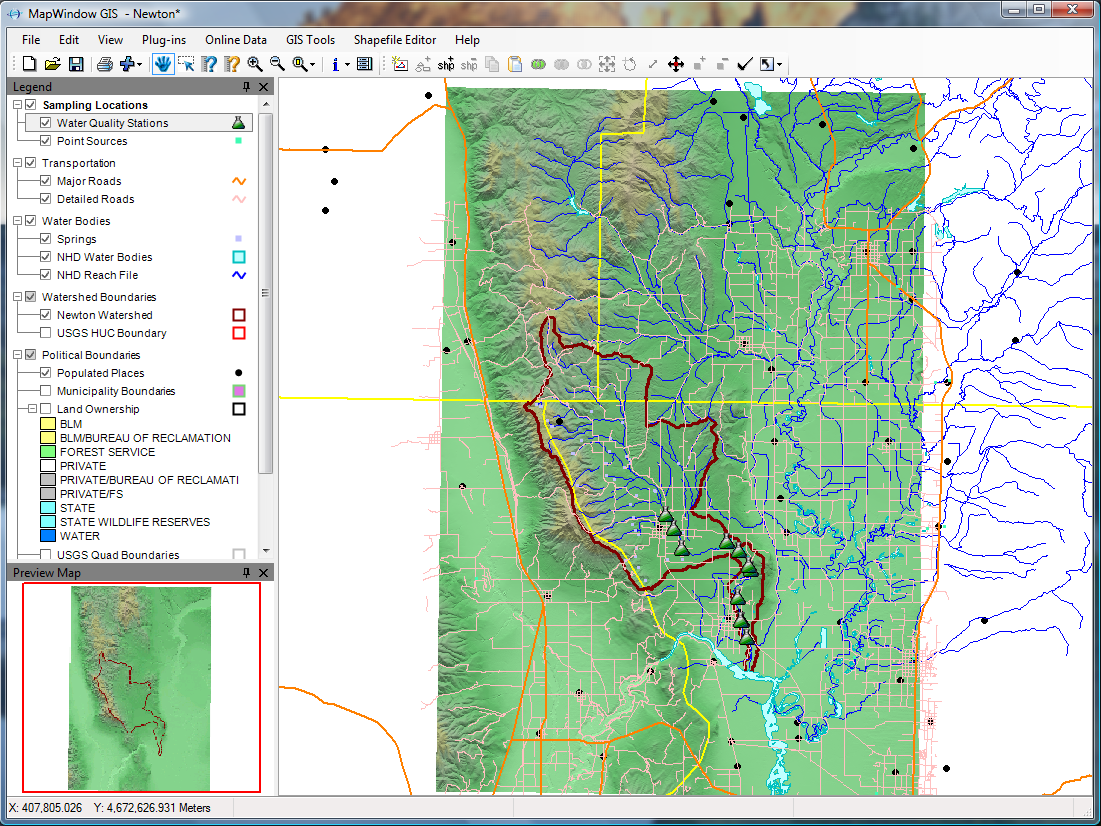
MapWindow GIS- Is a windows specific program and another full featured GIS system. The developers constantly revise and update the software adding more features and stability. It has many features that make the software package impressive and easy to use. (Windows)
http://www.mapwindow.org/  


Wikipedia
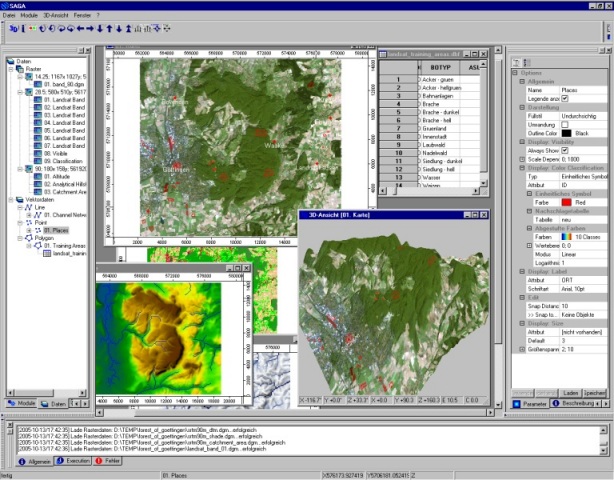
SAGA (System for Automated Geoscientific Analyses)- This one is new to me. I learned about it a short time ago and decided to check it out. 
It seems as though SAGA is packed with features as well, and can load many of the Esri files. I have not used this program other than explored some o its features, but again its free. SAGA touts itself as a "user friendly" application, judging by its interface, I would say that it is. Check it out, its a small file size, so don't be afraid to give it a try! (Windows, Linux)
http://www.saga-gis.org/en/index.html


Computer Aided Drafting


Wikipedia
LibreCAD- A small lightwieght 2d CAD program that has finally made it 1.0! It's small, compact, and easy to use. It has a few features missing that AutoCAD has, but then LibreCAD isn't a AutoCAD replacement. I use to to plot out excavation grids, test units, and shovel tests. I save those as DXF files and import them into Inkscape for further processing. Sure maybe AutoCAD can do everything I want, but why pay thousands of dollars for it when i can use free programs to get the same job done? 
http://librecad.org/cms/home.html


Office Suite


Wikipedia
LibreOffice- I've used OpenOffice for years, but switched when Oracle bought the code. LibreOffice is a Microsft Office replacement. It is also Free! LibreOffice can open, save, export, to all Microsoft document files, and it uses the Open Document Text and all Open Document file types. LibreOffice includes a Word (Writer) Power Point (Impress), Access (Base) , Excel (Calc), replacement and even a drawing program! I have typed many site reports, research papers, and made countless power Point presentations to use while teaching classes with LibreOffice. Please it is worth a look, and its Free! 
http://www.libreoffice.org/ 


      These are just some of the programs out there that can take the place of, or supplement the existing programs offered by large corporations. Many of the developers of these programs I've listed here represent non-profit foundations, or the hard work of individuals. As always, if a free program makes you money, please give a little back to these organizations that made the choice not to sell their programs. Archaeology can be fun and expensive, hopefully some of these programs can help bring down the cost and add a layer of additional analysis to your projects!
Enhanced by Zemanta

Monday, August 1, 2011

Archaeology Day in D.C.


Susan posing with Day of Archaeology banner.
Day of Archaeology was celebrated in Washington D.C on July 30th. The sponsors of the event was a nonprofit organization called Archaeology in the Community http://archaeologyincommunity.com/. My fiance Susan lives in the DC area, and it was pure luck that this event was happening as I was down there visiting.

Left-Andrea Harrison             Right-Alexandra Jones
I met the Chief Executive Officer of Archaeology in the Community, Alexandra Jones along with Andrea Harrison a board member for the organization. One of the chief goals of Archaeology in the Community is outreach and education in the DC area.

Some of the activities in the area were sponsored by different local and even national organizations. The Society for American Archaeology;http://www.saa.org/was represented by Maureen Malloy who is the head of the Education and Outreach side of the SAA. At her booth children could sift through sand and discover artifacts. 
Maureen Malloy Society for American Archaeology

Other booths were sponsored by the Maryland Department of Highways and offered a variety of artifacts for people to handle and ask questions about. 

Archaeology in the Community represents everything that is right about outreach. While like many nonprofits, funding is sparse, Archaeology in the Community brings together several interests that stakeholders have: History, Archaeology, and Visual Learning. What I have found out through community involvement in Brownsville, Pennsylvania, is that people truly are interested in their community's past. In a place like DC where history has an "in your face" presence, what is lost is the average person.  
I had the opportunity to talk to Ruth Trocolli, DC's City Archaeologist. At her booth were artifacts from the everyday lives of common people in the 19th Century. Her table garnered the most interest from people there, and perhaps generated the most discussion. Why? Because the artifacts there dealt with things you and I can relate to. An inkwell, a pencil, glass bottles, and porcelain dolls. Objects that everyday people can understand and place back into the hands of the past owners. 

Community archaeology will always be difficult. There are a vast majority of people who revel in the ability to examine and hold the past in their hands. These people enjoy the artifacts, but cannot commit themselves to the discovery end of archaeology- the digging. At Brownsville Archaeology Month we had visitors of every kind, but we were thirsting for volunteers who wanted to get dirty. I pleaded with my Facebook followers to please come down for a day and just experience what is to dig and discover. I had out of hundreds, one or two come down. A small contingent of the hundred who follow Brownsville Archaeology Month on Facebook. This will always be a problem for community outreach programs in archaeology. When I head to DC in the fall, I plan on becoming a part of this organization and help further their cause. We have to place artifacts into the stakeholder's hands.
That is the importance of community archaeology, make the distant past just a little closer. 


Enhanced by Zemanta

Tuesday, July 26, 2011

Who was Captain James Gormley?


California University of Pennsylvania Field School Students
excavating a portion of foundation at the Gormley House 2011
     As an industrial archaeologist often times I get caught up in the when and the how of an artifact, while leaving the who to the subtle recesses of theory and imagination. After all, when studying industrial places, the nameless working-class are just that, nameless. Records get destroyed, people moved about the landscape from job to job leaving little of their personal identities behind. As an anthropologist, the who takes center stage. The missing records are a challenge, the endemic community becomes an untapped resource while searching for those individual workers who struggled like you and I for our jobs, our families, and our existence. They held and loved their children as we do, and had many of the same concerns as we have today. They worried about the next paycheck, the next meal, and their job security. It is these people whose story brings the archaeology to life and gives it meaning. It is here where I will begin my story of steamboat captain, and how my crew is giving him a life after death.
     James Gormley resided in a wood frame house build on the mid-slope of a hill overlooking the town of Brownsville, Pennsylvania. From his front yard he could look out over the Monongahela River and see the wharf where his steamboat would make many landings over the course of several decades. His house was built and owned by his possible brother, uncle, or cousin, John A. Gormly in the 1830s. At this point in the research we are not sure of his familial ties with John. John A. Gormly was born in 1804, Captain James Gormley was born in 1817, so they could possibly be brothers.
     James' early aspirations and influences for a life on the river are unknown. He is listed as a steamboat captain in the 1850 census at the age of 33. Brownsville during this time was an active hub for shipping and emigration as people sought their fortunes westward. The town had a diverse industrial and mercantile business based on the frontier economy that existed at the time. Roads were poorly built, poorly mapped, and often dangerous as they headed toward the Mississippi Valley. The Monongahela provided a convenient, fast, and relatively safe way for transporting goods and people. James probably spent his boyhood down at the wharf or swimming in the river as the colossal white steamboats plied their way into a boy's imagination.
     Captain Gormley can be compared to a modern-day truck driver. He probably owned a share of his steamboat along with other investors, or owned it outright and worked to pay it off. His home life was sporadic, with long intervals of life on the river, his steamboat probably felt more like home than his physical house. In the 1850 census, James, age 33, was living with his wife Sarah, age 31. Their children were listed as follows: Frances (18yrs, female), John (10yrs, male), Henry (7yrs, male), Neal (5yrs, male), and Charles (2yrs, male). There were, however, other people also living in the Gormley household. These people deepen the mystery of the captain's life outside of his work.
     There were 10 non relatives living in the Gormley home. Jane Rhredes (22yrs, female) and Olive Fullen (23yrs, female) who were not listed as having an occupation. The other eight people were recorded as African-Americans. Their names were as follows: Margarett Fairfan (53yrs, female), Emily Fairfan (23yrs, female), Owen Fairfan (17yrs, male), Caroline Fairfan (16yrs, female), James Fairfan (14yrs, male) of New York. Mary Plummer (9yrs, female), John Plummer (7yrs, male), and Fenten Plummer (38yrs, male) of Fayette County, Pennsylvania. Owen Fairfan and Fenten Plummer were registered as “Laborers” on the 1850 census. The question is, who were these African-Americans living in the Gormley household?
Whole map of the underground railroad.Image via Wikipedia
Underground Railroad
     Brownsville had a long history of anti-slavery in the 19th century. Due to its location on the National Road and the Monongahela River, Brownsville became an important center for the Underground Railroad. The prominent Bowman family of the town often provided a safe haven for the blacks who escaped the shackles of slavery in the South. The Bowmans were merchants, steamboat builders, and political figures in western Pennsylvania. James Gormley as a steamboat captain, would have had contact with them.
     James Gormley, in his travels to Southern ports, could have easily ferried escaped slaves to start a new life in the North. Although listed on the census as from “New York” or “Fayette County”, these African-Americans could have covered up their real origins. Could these people have been just boarders, perhaps working for the Gormley family while James was working on the river? These are just some of the questions that I am trying to answer archaeologically.
     The bigger picture is tying James Gormley to John A. Gormly the prominent banker from Bucyrus, Ohio. I don't feel that it's a coincidence that James is living on John's property. The very transient nature of the steamboat industry may explain why James never bought the home.
By the time the 1860 census comes around we find a few changes in the composition of the Gormley household. Captain James (43yrs, male) and Sarah (41yrs, female), Francis (21yrs, male), John (19yrs, male), Henry (17yrs, male), Neil (15yrs, male), Charles (12yrs, male), and the new additions to the family; Sallie (10yrs, female), William (7yrs, male), James (3yrs, male), and Nellie (3yrs, female). A single African-American girl is living with the family at this time, May Galatin (15yrs, female).
     In the decade since the 1850 census, the Gormley children are pursuing their father in the business of steamboating. Francis, James' oldest son was documented in 1860 as a Boat Laborer, while John was a Pilot Apprentice, and Henry was working as an Engineer's Apprentice. The river life was influencing factor in the Gormley family, and their history along with their future in the mid-19th century are inescapably linked.
     As a captain, James Gormley's piloting record in Brownsville is scarce. We know that he piloted two boats, the Statesman in 1851, and the Jesse R. Bell in 1859. By 1862, James Gormley has left Brownsville, and we find him performing his duty as a steamboat captain for the Union at the start of the Civil War. Captain Gormley finds himself the master of the steamboat Empress. This places Captain Gormley at the Battle for Pittsburgh Landing in what would be known as the Battle of Shiloh. Taken from the Daily Missouri Republican on March 25, 1862:

On Tuesday, the 4th instant, the steamer Empress left St. Louis, having on board some 700 tons Commissary stores for Cairo and Paducah, 150 head of cattle for Fort Henry and Col. Bissell's Engineer Regiment, destined for Gen. Pope's Division at Commerce, Mo.,; Wednesday landed the troops at Commerce and Commissary stores at Cairo, coaled and arrived at Paducah on Thursday morning, received on board the Forty-eighth Ohio Infantry, Col. Sullivan commanding, coaled and arrived at Fort Henry Friday morning, being the first arrival for the new expedition; the water had almost completely inundated the Fort; no landing there; proceeded up the river about seven miles; landed in the brush, alongside the Gladiator, Gen. McClennand's headquarters, received a present from Lieut. Col. Parker, of the Forty-eighth, of a splendid American eagle, whose perch is now on the pilot house of the Empress. Here, on Saturday, the 8th, commenced a new phase in steamboating--the Empress is converted into a slaughter house to supply the much needed beef to the army, but "some things can be done as well as others," and there is room on the Empress to do almost anything, and Captain Jas. Gormley and his crew are the men to put things through (http://www.48ovvi.org/oh48pitts.html).

Carl Maurer Society for Pennsylvania Archaeology
Mon/Yough Chapter #3 Vice President
examining an excavation unit.
     This is the last piece of information written that has been discovered so far in our research. Through the archaeology we can supplement the documentary research and perhaps gain insight into the captain's daily life that the historians left out. We might even be able to find insight on the other non family members who were boarding with the Gormley family.
     Artifact analysis is just commencing on our finds, but some of the materials may tell us about the gender of those living in the house, the class status of those people, and even the race. The artifacts may reveal the struggle of everyday life in the mid 1800's for a person living in Brownsville, and it may shed light on the daily hardships of those working on the river. Click on the video below as I give a brief tour of Captain Gormley's home!   

Enhanced by Zemanta

Monday, November 29, 2010

Brownsville Redevelopment


A visitor walking through the streets of Brownsville with no prior
knowledge of the town,would be struck by a series of feelings.
One of these feelings might be of wonder as they try to piece the
broken picture of the town together in their mind of what it might have
looked like in its heyday. Another thought would surely be of its present
day condition, ruined, empty,and quiet. How they would think, could a
town with such beautiful architecture be in such a deplorable condition?
They may in that instant, understand the immense history of this place,
a history that is hidden to most in the windowless buildings, the empty
facades, and theghost town appearance that Brownsville reflects.


As an industrial archaeologist who was born and raised in Brownsville,
the town's history is my history. I have tried to help out where ever I
could, and in my research for my dissertation, I have talked to many
folks who lived in town when it was seemingly booming. I have
encountered two types of people who live in our town, those that want
to preserve it, and those that want to tear it down. Rarely do the two
ideologies meet in the middle.
To both sides, I ask this, “what is the largest industry in the world?”
The answer is heritage tourism. By and large, throughout the world,
especially in Europe, small towns that suffered economic disasters
realized that tourists like to see old buildings especially if you could
tie an interesting history to them. Take for example in Sweden
where they reuse old dilapidated industrial buildings by turning them
into apartments. Closer to home in Michigan's Upper Peninsula,
the copper mining patch towns are realizing that there are people
from around the world interested in mining and who
travel there just to see how copper was mined.


Brownsville has three focal points to heritage tourism.
The first one is the Dunlap's Creek Bridge. As an industrial archaeologist,
I have been to conferences where the main draw is bridges and bridge
construction. Currently, most of the span is covered by previous construction.
This is not really an issue. The issue is the invasive knotweed that covers the
banks. Cooperation to have that removed during the 2009 July 4th celebration
was met with hostility from the governing body of the town. The focal point that
would generate the most tourism interest should be the bridge. People identify
easier when they are told that something is the first of its kind. The second
focal point is Bowman's Castle. It is the most easily recognized structure
on the landscape as people come across the bridge. The third resource
Brownsville has in its favor is the Monongahela River. The promotion of
the history of the river in the development of the United States cannot
be over stated, and yet in our town, few people fully understand
how Brownsville contributed to western expansion. The invention
of the western steamboat to funding the locks and dams on the
Monongahela River, Brownsville was the center of it all. Yet there is little
that a visitor new to the town would be able to discover on their own.


So what is the solution? How do we pull in visitors who may want to stay
and invest in Brownsville? First, we need local history
(with a Brownsville focus) taught in our schools with knowledgeable
people talking to the students. Second, we have to put ourselves out there.
There should be an advertisement in historical magazines touting the first
cast iron bridge in the United States. We cannot wait for development to
find us --but we have to seek it out. Third, cut the petty infighting and political
nonsense between the City of Brownsville, BARC, and the Historical Society.
This town needs collaboration not division. We can see what division has done
already and it is not an alternative. I think we need to have someone documenting
the town and coming up with a car tour or walking tour. If the building isn't there,
so what? Have a picture of it and its importance. Our town's heritage was
steamboat building, we built over 800 of the boats. We are ground zero for western
river steamboat innovation and development. Let's devise a tour based on
that, where people can see where prominent captains, workers, and boat builders
were. However, we first have to see value in what we have. If we don't feel that
Brownsville is valuable, then it has no worth. We will have a parking lot and not a
single reason to park there.


I want to invite people from all around the world to visit Brownsville,
Pennsylvania. Relish in its industrial 19th century history, and be absorbed
into its decay. Yes, that's right. I want you to come and see the decay the
20th century and its deindustrialization has done to this once thriving town.
I invite you to look at the Dunlap Creek Bridge and think about the promise
it held for the fledgling United States, and look at it now for what it is, a
forgotten artifact of the first half on the 19th century. When you come an visit,
pass judgement not on what you see today, but on what could be done in the
future to create a  sustainable economy here in this town on the frontier.


Marc Henshaw (Archaeology Dude)

Dunlap Creek Bridge
Nemacolin Castle


Tuesday, March 23, 2010

The Lost Diary of Robert Rogers.

Hello All!

Industrial Archaeology is often associated with excavations and artifacts that open small windows into the past. However, historical archaeology starts in books and documents long before a shovel pierces the ground in most cases. Today I'm attempting to harness technology (the Internet) and my readers to help me find a piece of lost history. This little window into the past was written by a man who lived in Brownsville/Bridgeport, Pennsylvania and was a potter. Actually from reading the only know excerpts he was a jack-of-all-trades. Potter, steamboatman, steamboat builder, fireman, and justice of the peace to name a few. His name was Robert Rogers. (No, not Major Robert Rogers of the Detroit campaign.) Here is an excerpt from his diary taken from Franklin Ellis "History of Fayette County, Pennsylvania" 1882:

  Robert Rogers was born in Queen Anne County, Maryland, January 15th 1794 and after the death of his father in 1806, lived with his uncle until the fall of 1807. At that time another uncle, Lambert Boyer, who had settled in Washington County, Pennsylvania, visited Maryland and decided that young Robert should return with him to the west. Once they reached Dunlap’s Creek in Pennsylvania, Robert Rogers decided to stay with his Uncle Isaac Rogers who was living in the Bridgeport area.

On his arrival at Bridgeport, Robert was placed in the store of his Uncle Isaac, and also attended school during the small portion of time in which schools were taught at this place. In the fall of 1809 he was apprenticed in Bridgeport to Cephas Gregg to learn the trade of potter. “ I continued to work”[says Rogers] “ at my trade as apprentice till the middle of January, 1815, when I was 21. Then I left Bridgeport on a flatboat, and went to Pittsburgh for work.” There he was employed in a queensware factory. “Queensware was scarce, and ours sold readily and high.” After the Treaty of Ghent and the Battle of New Orleans, a flood of imports made it difficult for the potters to compete. Robert Rogers returned to Bridgeport in the Spring of 1815 and worked in the shop of John Riley until the fall of 1815… Then he was employed on a steamboat on the river; visited New Orleans in the spring of 1816; in the following fall returned to Bridgeport, where he married and undertook the shop for Cephas Gregg on shares. He again went on the steamboats in 1818 and returned once again to Bridgeport. He died of paralysis on January 27th, 1866, age 72 years.

“About 1811, Daniel French arrived here from Philadelphia with big schemes of manufacturing, steamboat building, and navigating western waters. He told people great advantages would accrue, and induced many prominent citizens to subscribe to stock for a cotton factory and two steamboats, all new to people here; but they were wise enough to secure charters for each company, viz., one for the factory and one for the steamboats, and they felt a deep interest and believed French, the people subscribed liberally to both. Work commenced, but the enterprise was new to all, and it was a long time before it was completed. And when they were ready there was no one experienced in running factories or steamboats, and neither enterprise made money, but run in debt, and the factory was sold by the sheriff, and the boats were sold by the company after they had run them as long as there seemed any hope of profit.”

Many local historians, including myself are looking for this diary or a copy of it. Any information, including those of living relatives is greatly appreciated!
Reblog this post [with Zemanta]

Tuesday, October 20, 2009

Current Side Quest

Hi All!

I just wanted to share with all of you a little side project I'm delving into. In my home town, Brownsville, PA, we have had many firsts. We had the first toll road in the United States, the National Road (Route 40), we had the first cast iron bridge, the Dunlap Creek Bridge, we have the oldest market district west of the Appalachia Mountains, we had the first house built with wooden shingles west of those mountains. We also had another first, one that stands in the back of the minds when we think of the golden age of transportation, especially river transportation. I'm thinking of the steamboat. No we didn't build the first steamboat. Instead we made it better.

Henry Shreve (for which Shreveport Louisiana is named) lived in Brownsville and a man by the name of Daniel French. They made the steamboat better, by tailoring the vessel to the inland water ways and foregoing the sea going designs of the 18th century. So where lies the first? We built the first steamboat that traveled from the Monongahela Valley, up to Pittsburgh (Monongahela River flows north) and down the Ohio River to the Mississippi River to New Orleans and return under its own power in 1814. The boat was named Enterprise, and this new technology revolutionized the way people and goods were transported.

The side quest of mine just happened to have taken me to the front door of the house where these men first created the Monongahela Steamboat Company along with Elisha D. Hunt, Robert Rodgers, and Elijah Clark. I have found the birth place of this enterprise, called the Bridgeport Manufacturing Company's Cotton Factory. And it is scheduled for demolition.


More on this to come...
The building is the white structure between the fork in the roads with the three trees in the front.

(From 1883 Birds Eye View map of Brownsville- Library of Congress)


Reblog this post [with Zemanta]