Sunday, May 13, 2012

Brownsville Archaeology Month Day 3

Hello All,


Munsell Color System
Munsell Color System (Photo credit: Crossett Library Bennington College)
       Here are some more exciting pictures from the Snowdon & Sons Vulcan Iron and Machine Works at Brownsville Archaeology Month! Friday, May 11th represented the third day of our excavations. We mainly had administrative work to do, mapping Munsell color testing, and some equipment repair. Enjoy!

Erin Morgan examining a piece of metal strapping.

Sean Rothhaar repairing a screen, a thankless job!

Jonathan Crise screening for artifacts.

The point of discovery!
 
Enhanced by Zemanta

I'm tired of teaching what was here...

Hello Everyone,

This little post comes after some feedback on my Facebook page. I thought it was appropriate so I'll post it here as well. The discussion started as several of our historic buildings here in Brownsville, Pennsylvania are being threatened. Not threatened by developer or the state; no they are threatened by the people we elect into our local government.

You expect that the people we elect to be the stewards of our town, they would protect that which is valuable to its community and preserve the fabric of our heritage. Instead, to your face they speak of valuing the core of the community but in their seats of power they tear the very fabric down. Instead of preserving and look to the future they are blind to the past, only because they do not understand that the wealthiest of communities have embraced their heritage and profited from it.

Two million dollars were allocated to Brownsville. I heard two million reasons to tear it down, and not a single reason to preserve it. These politicians want to rule over a community of rubble. In one instance a comment was made on Facebook over the destruction of the Mitchell House by a senior member of the Brownsville Council, "Tear it down!". How can we move forward as a community when those elected prefer a wrecking ball over using their head to move the community forward? I cannot take a stand alone, the culture of the community must change. I'm tired of teaching about what was there; it would be nice to teach about how we saved the town.


http://www.archaeologydude.com/2009/10/current-side-quest.html


Photo courtesy of Phillip Shandorf

Mitchell House. Photo courtesy of the Brownsville Telegraph Online. 


Enhanced by Zemanta

Thursday, May 10, 2012

Snowdon Foundry: Brownsville Archaeology Month Day 2

Hello Everyone,


I'd like to share a few picks from today's discoveries. I also have some mystery artifacts that are always fun. I have to make one correction from yesterday's post, we DID NOT find a railroad datum point. It turned out to be one of these: 

Mystery items!


Erin Morgan and Carl Maurer Mapping their Unit 
Liz Atkin preparing her Excavation Unit for a Photo

   
Enhanced by Zemanta

Foundry Rising!

Hello Everyone,


       Yesterday was the start of this year's Brownsville Archaeology Month! The day was filled with one fascinating find after the other, opening small windows into a complex past of the John Snowdon and Son's Vulcan Iron and Machine Works. The work was hard using picks, maddocks, and of course trowels and shovels to excavate down almost three feet (1 meter) to buried foundation below. 


Phil Shandorph, Carl Maurer, and Jonathan Crise


     Some of the cool artifacts that we recovered are in these photographs:


Whiskey Bottle
 Alcohol bottle found outside one of the shop's footers. Alcohol bottles may indicate resistance of workers in the foundry to the strict rules that often governed their conduct. 
 It is not often in Archaeology when you find a name carved in stone of the object of your research. Here we have the name "Vulcan". The foundry, like others in the area, was known as the Vulcan Iron and Machine Works.
Carl Maurer


Stay tuned! 
    
Enhanced by Zemanta

Tuesday, May 1, 2012

Snowdon Vulcan Iron and Machine Works Discovery!


Hello Everyone,
        I would like to take a few moments and present an important discovery in American Industrial Archaeology. Myself, along with members of the local Society for Pennsylvania Archaeology Mon-Yough Chapter #3 have located and begun excavation on the Snowdon Vulcan Iron and Machine Works located right here in Brownsville, Pennsylvania. As you read on, you will notice reference to the nation's first cast iron bridge, a symbol which will become the cornerstone to Brownsville's redevelopment in the 21st-century.

1886 Sanborn Fire Insurance Map showing the Foundry
Aerial Photograph with Foundry Overlay 
     The turn of the 19th century and the introduction of steam power ushered in a new industrial rush in Brownsville and Bridgeport, Pennsylvania.  In 1818, John Snowden arrived in Brownsville from Yorkshire, England (Ellis 1882; Gresham and Wiley 1889).  After apprenticing for a few years in a local foundry, he opened his own machine shop and rolling mill within close proximity to the riverbank.  Named after the Roman god of fire, the Vulcan Iron and Machine Works opened in 1824.  The Vulcan factory built the engines for the steamer Monongahela in 1827.  Snowden improved and extended the factory in 1831. In 1853, the establishment burned down and was subsequently rebuilt.  The business renovated to include a forge, rolling mill, pattern shop, foundry, boiler yard, and finishing shop all located on an acre of land on the bank of the Monongahela River (Kussart 1930; Thurston 1859).  The main two-story buildings were made of brick and faced the river.  The purpose of this main building was the finishing shop where parts were completed.  An excerpt from Thurston’s (1859:34) town directory describes in detail the factory:

"Within its walls and distributed over the use of two rooms, with nice regard to their convenient use, is gathered a large amount of machinery, of the latest improvements, adapted to all the requirements of machine manufacturing; among them are 19 turning lathes, 6 planning machines, 4 boring machines and 8 drill presses.  There upon the lower floor, 10 blacksmith fires, with all of their accompanying cranes, steam forge hammers, and etc.


     The foundry and finishing shops were constructed of brick and connected with the main building.  This area contained cranes and two large 12-ton capacity cupolas for delivering molten iron.  The foundry was in the forefront of the rolling mill and the forge was contained in another one story building.  Within this structure were six pairs of rolls, two puddling furnaces, two heating furnaces, one spike and one rivet machine that turned out 600 tons of bar iron a year (Thurston 1859).  A pattern shop used for cutting different shapes of metal adjoined the foundry."

     The Vulcan Iron and Machine Works, later called Snowden & Sons, employed 110 people with a weekly wage of $6.83 per person (Thurston 1859).  This factory produced a similar number of land use stationary steam engines such as those used to power the large belts of the machine shop.  The convenient location of the factory next to the Brownsville wharf allowed engines to be fitted to hulls while incoming boats unloaded goods. In 1863 the Vulcan Iron and Machine Works built the engines and boilers of the ironclads Manayunk and Umpqua.
1901. Photo Courtesy of  Donna Edwards-Jordan

     John Herbertson arrived
 in Brownsville in 1829 after learning the trade of steam engine building in Pittsburgh.  Originally from Glasgow, Scotland, Herbertson became a foreman in the Vulcan 
Iron and Machine Works engine shop.  When the wooden bridge 
collapsed over Dunlap’s Creek connecting Brownsville to 
Bridgeport, Snowden took the contract for the erection of a cast 
iron bridge (Ellis 1882; Kussart 1930; Thurston 1859).  This is  the 
first cast iron bridge in the United States.  Herbertson designed the 
bridge and supervised its construction (Gresham and Wiley 1889).  
A teaser image from some preliminary testing.
Herbertson eventually went into a partnership with Thomas Faull who was already operating a small foundry in Bridgeport.  Together they formed the Fayette Foundry, until 1842 when Faull withdrew from the partnership (Ellis 1882).  Herbertson later created Herbertson & Company with his sons in the 1880s as the business grew.

There will be more to follow as this project moves forward. Stay tuned! 

Text taken from:
Henshaw, Marc
2004  THE STEAMBOAT INDUSTRY IN BROWNSVILLE, PENNSYLVANIA: AN ETHNOHISTORICAL PERSPECTIVE ON THE ECONOMIC CHANGE IN THE MONONGAHELA VALLEY.

References:
Ellis, Franklin
1882  History of Fayette County, Pennsylvania with Biographical Sketches of Many of its Pioneers and Prominent Men.

Gresham, John and Samuel T. Wiley
1889  Biographical and Portrait Cyclopedia of Fayette County, Pennsylvania. John M. Gresham, Maging Editor.

Kussart, Sarepta Cooper
1930 Navigation on the Monongahela River. Unpublished Manuscript.

Thurston, Geo. H.
1859  The Rivers and Valleys of Pennsylvania Then and Now.

Enhanced by Zemanta

Sunday, April 1, 2012

Part 2. A Structure Forgotten: The First Cast Iron Bridge in the United States

http://explorepahistory.com/displayimage.php?imgId=1-2-E4E
Hello everyone, 


I decided to follow up and show an expanded detail of the Dunlap's Creek Bridge located in Brownsville, Pennsylvania. This  great structure  has largely been forgotten by the citizens of the United States.


This series of posts has to do with a big announcement I will be making on here in the up coming weeks about a find related to the bridge, that may shed some light on the early history of its construction. 

Another view of the bridge
Coalbrookdale Bridge 1779 Wikipedia

The Dunlap's Creek Bridge is not a celebrated structure in the US as the Coalbrookdale Bridge is in England. For those of you who may not know, the Coalbrookdale Bridge is the first cast iron bridge ever constructed. Located in England, the bridge crosses the River Severn in Shropshire.

 
Henshaw 2011
Our first cast iron bridge is more of an enigma. Nestled on a narrow point on Historic Route 40, the bride is easy to miss. There is no fanfare, signs, or anything that jumps out at the motorist driving over what appears to be a hump in the road. The town of Brownsville, once a thriving industrial center, is now largely empty. It's leadership has failed to grasp the commercial value of the bridge or the symbol that it stands for in American history. What should be the centerpiece of the town is instead a curiosity which no-one seems to know what to do with. There was a mural placed on a building showing the bridge when it was newly constructed. It's nice, but why not just show people the bridge? I invite all of my readers to make a pilgrimage to Brownsville, Pennsylvania this May, 2012 where I promise to give you a personal tour of this great structure.  

In the mean time, here are some great drawings from the Historic American Engineering Record (HAER for short). These illustrate the construction methods used in building the bridge. Here is the website for further reading: http://www.loc.gov/pictures/item/PA1412/  

HAER Library of Congress
"The bridge was constructed of 250 castings and spanned 80 feet. There were 5 elliptical tube cast iron arches spaced 5 feet 10 inches apart. Each arch tube was made up of 9 voussoirs that were connected by a flanged collar held together by bolts. Each arch was attached to an iron spring plate that rested on a stone abutment. The sandstone abutments were 42 feet high and 25 feet wide. The arches were held in place by St. Andrew’s crosses for bracing purposes." 

HAER Library of Congress
From the illustration, it is easy to see the elliptical castings of the voussoirs and their flanges. Voussoir is basically a wedged shaped piece of an arch in stone masonry. Each of these voussoirs in the Dunlap's Creek Bridge are held together by a flange. In a stone arch, the voussoirs would be held together by a keystone at its center. Captain Delafield understood that the ability to cast iron into an elliptical tube and connect the pieces together would negate the need for a "keystone" as the weight of the arch is spread out over the tops of the arch by the St. Andrews Crosses. 


Dunlap's Creek Bridge, Spanning Dunlap's Creek...
Dunlap's Creek Bridge, Spanning Dunlap's Creek, Brownsville, Fayette County, PA (Photo credit: Wikipedia)
Currently, the bridge is mostly obscured by vegetation overgrowth and the remains of two buildings that flanked it on either side. Access to the structure is limited due to the steep slopes of Dunlap's Creek channel. Perhaps one day Brownsville will capitalize on this unique structure, and look to Coalbrookdale as a model.   


Enhanced by Zemanta

Friday, March 30, 2012

Part 1. First Cast Iron Bridge in the United States


Photo by Marc Henshaw 2004
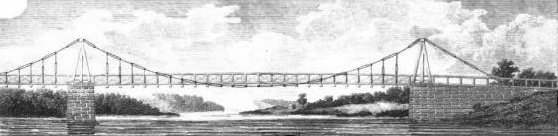
     Dunlap’s Creek, flows into the Monongahela River, separated the two distinct towns of Brownsville and Bridgeport, Pennsylvania. Both of these areas would later consolidate under the name of “Brownsville” in the early 20th century. Spanning this gap across the creek were several bridges of various designs at different time intervals. The first bridge is of unknown construction was destroyed by a flood in 1808. A more modern suspension bridge was constructed in its place using chain link and a wooden deck that was secured to stone abutments to span the creek channel. This bridge was constructed by Judge James Findley who is considered the father of modern suspension bridges and was a local resident of Brownsville. He is most famous bridge was at Jacob’s Creek in 1801 that became the model for suspension across Europe and the United States. Unfortunately this design too failed when it collapsed in 1820 when a wagon pulled by six horses was crossing it during a snow storm. There were two other bridges built at this location of
Chain Bridge Findley Design
 which little is known about their construction. The fourth bridge was made of wood and constructed out of necessity to continue unimpeded traffic until a fifth and stronger bridge was built.
            Brownsville was chosen for the first cast-iron bridge for several reasons. The town was located on an iron seam that had been exploited since the founding of the town and its iron working traditions. There were multiple foundries located in Brownsville more than any other along the National Road, one being the Vulcan Iron and Machine Works run by John Snowden. His specialty was steam engines and hulls, but he had cast all of the iron mile markers along the Cumberland Road. The available foundries made Brownsville, in the eyes of the engineers who would construct the bridge, an excellent choice.
            The development of the National Road system between 1811 and 1832 put the control of the toll road in the states it passed through. The tolls maintained the road and its infrastructure. However, before the states gained control of their sections, the government agreed to repair the road and build tollhouses to support its cost. This initial thrust to bring the road into good condition also involved the Army Corps of Engineers to replace worn and damaged bridges.
Richard Delafield
Richard Delafield (Photo credit: Wikipedia)
            The supervising officer in the Army Corps of engineers who oversaw the construction of bridges throughout the National Road was Captain Richard Delafield. Delafield graduated from West Point Military Academy with an engineering focus. Robb points out at the time; the curriculum was heavily influenced by the French in approach. However, he also received training in the British school of application and practical training. It would be the British use of cast iron for bridge construction that would influence Delafield to use the material over Dunlap’s Creek.
            Captain Delafield hired two founders located in Brownsville, John Snowden and John Herbertson. Snowden was an immigrant from Yorkshire as a blacksmith by trade. Herbertson was Snowden’s apprentice foreman. He was from Scotland and had a background as a fitter and cabinet maker. Delafield rented the Vulcan Iron and Machine Works where Snowden cast the iron and Herbertson cut the patterns for the new bridge. They were funded by the federal government for their labor.
            There of course were political delays in Brownsville about where to build the new bridge and what course the road would follow once it was completed. Bridgeport wanted a bridge to cross the Monongahela River at the entrance to their town. This would cause  a 900 bend in the road once across Dunlap’s Creek onto the river bridge. The political trouble lasted two years until Bridgeport lobbied the President of the United States who ruled in their favor. The construction could begin at greater cost in labor and materials over their original agreement.
            In 1836 140 tons of Iron was purchased from Portsmouth, Ohio and shipped to Snowden’s foundry. The bridge patterns were made and casting commenced. The bridge was constructed of 250 castings and spanned 80 feet. There were 5 elliptical tube cast iron arches spaced 5 feet 10 inches apart. Each arch tube was made up of 9 voussoirs that were connected by a flanged collar held together by bolts. Each arch was attached to an iron spring plate that rested on a stone abutment. The sandstone abutments were 42 feet high and 25 feet wide. The arches were held in place by St. Andrew’s crosses for bracing purposes. In total it took 300,000 pounds of cast iron and $40,000 dollars to complete.
            What is remarkable about this first cast iron bridge is the uniqueness of its design. Delafield had training from both schools of engineering in the 19th century, French and British. He chose a design that was neither. Frances Robb quotes Delafield in describing the difference in its “principle of construction from any of which I could find a notice of either English or French engineers.” The bridge also represents Brownsville’s devotion to iron and industrialization. The Snowden foundry never produced another cast-iron bridge; it focused its production on steam engines and steamboat hulls. Herbertson too started his own foundry in Bridgeport. His outfit never constructed another bridge but also focused on boilers and engines for steamboats.
             It is unfortunate that the bridge has been obscured by the region's de-industrialization. Cars and trucks many times the weight that any 19th century engineer would have envisioned traverse the span to this day. Only a small brass plaque points out the distinctiveness of the bridge and its significance to history.

References 
“Dunlap’s Creek Bridge,” HAER PA-72, Library of Congress
http://memory.loc.gov/cgi-bin/query/D?hh:1:./temp/~ammem_wZpn::

Hart, J. Percy
1904        Hart’s History and Directory of the Three Towns: Brownsville, Bridgeport, and West Brownsville. Cadwallder Pennsylvania: J Percy Hart.

Henshaw, Marc
2004    The Steamboat Industry in Brownsville Pennsylvania: An Ethnohistorical Perspective on the Economic Change in the Monongahela Valley.

Robb, Frances
1993        Cast Aside: The First Cast-Iron Bridge in the United States


Enhanced by Zemanta