|
| Photo by Marc Henshaw 2004 |
Dunlap’s Creek, flows into the
Monongahela River, separated the two distinct towns of Brownsville and
Bridgeport, Pennsylvania. Both of these areas would later consolidate under the name of
“Brownsville” in the early 20th century. Spanning this gap across
the creek were several bridges of various designs at different time intervals.
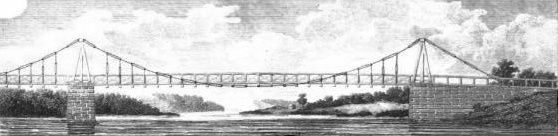
The first bridge is of unknown construction was destroyed by a flood in 1808. A
more modern suspension bridge was constructed in its place using chain link and
a wooden deck that was secured to stone abutments to span the creek channel.
This bridge was constructed by Judge James Findley who is considered the father
of modern suspension bridges and was a local resident of Brownsville. He is
most famous bridge was at Jacob’s Creek in 1801 that became the model for
suspension across Europe and the United States. Unfortunately this design too
failed when it collapsed in 1820 when a wagon pulled by six horses was crossing
it during a snow storm. There were two other bridges built at this location of
 |
| Chain Bridge Findley Design |
which little is known about their construction. The fourth bridge was made of
wood and constructed out of necessity to continue unimpeded traffic until a
fifth and stronger bridge was built.
Brownsville
was chosen for the first cast-iron bridge for several reasons. The town was
located on an iron seam that had been exploited since the founding of the town
and its iron working traditions. There were multiple foundries located in
Brownsville more than any other along the National Road, one being the Vulcan
Iron and Machine Works run by John Snowden. His specialty was steam engines and
hulls, but he had cast all of the iron mile markers along the Cumberland Road.
The available foundries made Brownsville, in the eyes of the engineers who
would construct the bridge, an excellent choice.
The
development of the National Road system between 1811 and 1832 put the control
of the toll road in the states it passed through. The tolls maintained the road
and its infrastructure. However, before the states gained control of their
sections, the government agreed to repair the road and build tollhouses to
support its cost. This initial thrust to bring the road into good condition
also involved the Army Corps of Engineers to replace worn and damaged bridges.
The supervising officer in the Army Corps of engineers who oversaw the construction of bridges throughout the National Road was Captain Richard Delafield. Delafield graduated from West Point Military Academy with an engineering focus. Robb points out at the time; the curriculum was heavily influenced by the French in approach. However, he also received training in the British school of application and practical training. It would be the British use of cast iron for bridge construction that would influence Delafield to use the material over Dunlap’s Creek.
Captain
Delafield hired two founders located in Brownsville, John Snowden and John
Herbertson. Snowden was an immigrant from Yorkshire as a blacksmith by trade.
Herbertson was Snowden’s apprentice foreman. He was from Scotland and had a
background as a fitter and cabinet maker. Delafield rented the Vulcan Iron and
Machine Works where Snowden cast the iron and Herbertson cut the patterns for
the new bridge. They were funded by the federal government for their labor.
There
of course were political delays in Brownsville about where to build the new
bridge and what course the road would follow once it was completed. Bridgeport
wanted a bridge to cross the Monongahela River at the entrance to their town.
This would cause a 900 bend
in the road once across Dunlap’s Creek onto the river bridge. The political
trouble lasted two years until Bridgeport lobbied the President of the United
States who ruled in their favor. The construction could begin at greater cost
in labor and materials over their original agreement.
In
1836 140 tons of Iron was purchased from Portsmouth, Ohio and shipped to
Snowden’s foundry. The bridge patterns were made and casting commenced. The
bridge was constructed of 250 castings and spanned 80 feet. There were 5
elliptical tube cast iron arches spaced 5 feet 10 inches apart. Each arch tube
was made up of 9 voussoirs that were connected by a flanged collar held
together by bolts. Each arch was attached to an iron spring plate that rested
on a stone abutment. The sandstone abutments were 42 feet high and 25 feet
wide. The arches were held in place by St. Andrew’s crosses for bracing
purposes. In total it took 300,000 pounds of cast iron and $40,000 dollars to
complete.
What
is remarkable about this first cast iron bridge is the uniqueness of its
design. Delafield had training from both schools of engineering in the 19th
century, French and British. He chose a design that was neither. Frances Robb
quotes Delafield in describing the difference in its “principle of construction
from any of which I could find a notice of either English or French engineers.”
The bridge also represents Brownsville’s devotion to iron and
industrialization. The Snowden foundry never produced another cast-iron bridge;
it focused its production on steam engines and steamboat hulls. Herbertson too
started his own foundry in Bridgeport. His outfit never constructed another
bridge but also focused on boilers and engines for steamboats.
It is unfortunate that the bridge has been obscured by the region's de-industrialization. Cars and trucks many times the weight that any 19th century engineer would have envisioned traverse the span to this day. Only a small brass plaque points out the distinctiveness of the bridge and its significance to history.
References
“Dunlap’s Creek Bridge,” HAER PA-72, Library of
Congress
http://memory.loc.gov/cgi-bin/query/D?hh:1:./temp/~ammem_wZpn::
Hart, J. Percy
1904
Hart’s History and Directory of the Three Towns:
Brownsville, Bridgeport, and West Brownsville. Cadwallder Pennsylvania: J Percy
Hart.
Henshaw, Marc
2004 The Steamboat Industry in Brownsville
Pennsylvania: An Ethnohistorical Perspective on the Economic Change in the
Monongahela Valley.
Robb, Frances
1993
Cast Aside: The First Cast-Iron Bridge in the United
States