Showing posts with label United States. Show all posts

Saturday, June 9, 2012

Snowdon and Sons: Random Archaeology Pictures

Hello Everyone,

        I thought I'd just post some random pictures from the excavation for some weekend viewing. Hope you enjoy!

Don and Carl

Julz excavating around bottles

Sean cleaning the foundation of debris

Our mascot Riley

A view of the foundation with railroad ballast (fill) on the left (dark Stain)

Enhanced by Zemanta

Thursday, June 7, 2012

Snowdon Foundry: Influencing the Younger Generation to Archaeology.

Hello all,


Zander Harden
 This is a mini post showcasing two of our younger members in the SPA Mon-Yough Chapter #3 who come out to volunteer. We hope that their exposure to archaeology and historic preservation will make them better stewards of our town's history. Because the excavations are public, we encourage children and young adults to come out and get a taste of discovery first hand. As archaeologists, sometimes we become desensitized to history, we ourselves begin to take it for granted. However, for the people, the stakeholders of the communities in which we live, us archaeologists are a bridge into their past. To many people, this bridge to the past is shrouded in a fog of misunderstandings, misconceptions, and often misguidance. We must reach out to the public for interpretation and acceptance of their past, no matter how harsh or contested. It is our job to hold the public's hand and guide them through the fog into a knowledgeable and tangible past. That is what sets us apart from historians, people can actually take the past into their own hands and ponder the artifacts and perhaps make a connection with those who created and used them. Children and young adults are the future consumers of heritage, if we don't educate them on what is valuable then we'll have many many more Rick Savages using a backhoe for a quick buck. Yet if we, the experts, teach the children of our community the societal and cultural value of archaeology and preservation, then perhaps we have justified our existence.  


Chaze Eddings

Chaze Working on Straitening those Walls!

Zander and Carl Exploring the North Foundation of SVIMW

Zander checking out his work.

I found Something!

Julz and Chaze cleaning out the South Excavation Block.


Enhanced by Zemanta

Tuesday, May 22, 2012

Archaeology useless? Not in educated society

Hello All,


        Here is an interesting article from the Columbus Dispatch. I believe that the author, Bradley T. Lepper from the Ohio Historical Society explains it well. To discourage bright, intelligent minds from archaeology, let alone any subject is wrong in our society. The very thing that makes the United States stand out, is that everyone has a choice in what they want to study and what career to follow. Granted, barring socio/economic standing! This article reminds me of the use rant that Governor Rick Scott from Florida went on about not needing any more Anthropologists in his state. What the hell is wrong with these people? I feel that as an archaeologist, part of these notions fall directly on myself and the archaeological community. I think we should be more visible in our places of residence and conduct more excavations at the community level. Thus Brownsville Archaeology Month. I couldn't tell you how many visitors reacted to the site as if I had just performed a magic trick, or revealed a hidden object from under a cloth. I guess that's what I did. Except my cloth is 3 feet of railroad fill and my hidden object is a 600ft iron foundry. to my fellow archaeologists, let's be more visible in our communities and more interactive with the very people who appreciate our finds. If we could all just give a few talks a year to a bunch of 6 year-olds or bring a bus of screaming kids out to our sites once in a while, maybe we can secure our own future.   


Archaeology useless? Not in educated society
Enhanced by Zemanta

Sunday, May 13, 2012

I'm tired of teaching what was here...

Hello Everyone,

This little post comes after some feedback on my Facebook page. I thought it was appropriate so I'll post it here as well. The discussion started as several of our historic buildings here in Brownsville, Pennsylvania are being threatened. Not threatened by developer or the state; no they are threatened by the people we elect into our local government.

You expect that the people we elect to be the stewards of our town, they would protect that which is valuable to its community and preserve the fabric of our heritage. Instead, to your face they speak of valuing the core of the community but in their seats of power they tear the very fabric down. Instead of preserving and look to the future they are blind to the past, only because they do not understand that the wealthiest of communities have embraced their heritage and profited from it.

Two million dollars were allocated to Brownsville. I heard two million reasons to tear it down, and not a single reason to preserve it. These politicians want to rule over a community of rubble. In one instance a comment was made on Facebook over the destruction of the Mitchell House by a senior member of the Brownsville Council, "Tear it down!". How can we move forward as a community when those elected prefer a wrecking ball over using their head to move the community forward? I cannot take a stand alone, the culture of the community must change. I'm tired of teaching about what was there; it would be nice to teach about how we saved the town.


http://www.archaeologydude.com/2009/10/current-side-quest.html


Photo courtesy of Phillip Shandorf

Mitchell House. Photo courtesy of the Brownsville Telegraph Online. 


Enhanced by Zemanta

Thursday, May 10, 2012

Foundry Rising!

Hello Everyone,


       Yesterday was the start of this year's Brownsville Archaeology Month! The day was filled with one fascinating find after the other, opening small windows into a complex past of the John Snowdon and Son's Vulcan Iron and Machine Works. The work was hard using picks, maddocks, and of course trowels and shovels to excavate down almost three feet (1 meter) to buried foundation below. 


Phil Shandorph, Carl Maurer, and Jonathan Crise


     Some of the cool artifacts that we recovered are in these photographs:


Whiskey Bottle
 Alcohol bottle found outside one of the shop's footers. Alcohol bottles may indicate resistance of workers in the foundry to the strict rules that often governed their conduct. 
 It is not often in Archaeology when you find a name carved in stone of the object of your research. Here we have the name "Vulcan". The foundry, like others in the area, was known as the Vulcan Iron and Machine Works.
Carl Maurer


Stay tuned! 
    
Enhanced by Zemanta

Sunday, April 1, 2012

Part 2. A Structure Forgotten: The First Cast Iron Bridge in the United States

http://explorepahistory.com/displayimage.php?imgId=1-2-E4E
Hello everyone, 


I decided to follow up and show an expanded detail of the Dunlap's Creek Bridge located in Brownsville, Pennsylvania. This  great structure  has largely been forgotten by the citizens of the United States.


This series of posts has to do with a big announcement I will be making on here in the up coming weeks about a find related to the bridge, that may shed some light on the early history of its construction. 

Another view of the bridge
Coalbrookdale Bridge 1779 Wikipedia

The Dunlap's Creek Bridge is not a celebrated structure in the US as the Coalbrookdale Bridge is in England. For those of you who may not know, the Coalbrookdale Bridge is the first cast iron bridge ever constructed. Located in England, the bridge crosses the River Severn in Shropshire.

 
Henshaw 2011
Our first cast iron bridge is more of an enigma. Nestled on a narrow point on Historic Route 40, the bride is easy to miss. There is no fanfare, signs, or anything that jumps out at the motorist driving over what appears to be a hump in the road. The town of Brownsville, once a thriving industrial center, is now largely empty. It's leadership has failed to grasp the commercial value of the bridge or the symbol that it stands for in American history. What should be the centerpiece of the town is instead a curiosity which no-one seems to know what to do with. There was a mural placed on a building showing the bridge when it was newly constructed. It's nice, but why not just show people the bridge? I invite all of my readers to make a pilgrimage to Brownsville, Pennsylvania this May, 2012 where I promise to give you a personal tour of this great structure.  

In the mean time, here are some great drawings from the Historic American Engineering Record (HAER for short). These illustrate the construction methods used in building the bridge. Here is the website for further reading: http://www.loc.gov/pictures/item/PA1412/  

HAER Library of Congress
"The bridge was constructed of 250 castings and spanned 80 feet. There were 5 elliptical tube cast iron arches spaced 5 feet 10 inches apart. Each arch tube was made up of 9 voussoirs that were connected by a flanged collar held together by bolts. Each arch was attached to an iron spring plate that rested on a stone abutment. The sandstone abutments were 42 feet high and 25 feet wide. The arches were held in place by St. Andrew’s crosses for bracing purposes." 

HAER Library of Congress
From the illustration, it is easy to see the elliptical castings of the voussoirs and their flanges. Voussoir is basically a wedged shaped piece of an arch in stone masonry. Each of these voussoirs in the Dunlap's Creek Bridge are held together by a flange. In a stone arch, the voussoirs would be held together by a keystone at its center. Captain Delafield understood that the ability to cast iron into an elliptical tube and connect the pieces together would negate the need for a "keystone" as the weight of the arch is spread out over the tops of the arch by the St. Andrews Crosses. 


Dunlap's Creek Bridge, Spanning Dunlap's Creek...
Dunlap's Creek Bridge, Spanning Dunlap's Creek, Brownsville, Fayette County, PA (Photo credit: Wikipedia)
Currently, the bridge is mostly obscured by vegetation overgrowth and the remains of two buildings that flanked it on either side. Access to the structure is limited due to the steep slopes of Dunlap's Creek channel. Perhaps one day Brownsville will capitalize on this unique structure, and look to Coalbrookdale as a model.   


Enhanced by Zemanta

Friday, March 30, 2012

Part 1. First Cast Iron Bridge in the United States


Photo by Marc Henshaw 2004
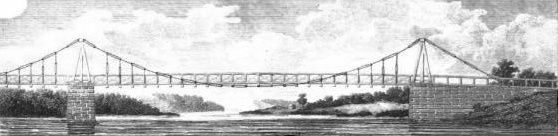
     Dunlap’s Creek, flows into the Monongahela River, separated the two distinct towns of Brownsville and Bridgeport, Pennsylvania. Both of these areas would later consolidate under the name of “Brownsville” in the early 20th century. Spanning this gap across the creek were several bridges of various designs at different time intervals. The first bridge is of unknown construction was destroyed by a flood in 1808. A more modern suspension bridge was constructed in its place using chain link and a wooden deck that was secured to stone abutments to span the creek channel. This bridge was constructed by Judge James Findley who is considered the father of modern suspension bridges and was a local resident of Brownsville. He is most famous bridge was at Jacob’s Creek in 1801 that became the model for suspension across Europe and the United States. Unfortunately this design too failed when it collapsed in 1820 when a wagon pulled by six horses was crossing it during a snow storm. There were two other bridges built at this location of
Chain Bridge Findley Design
 which little is known about their construction. The fourth bridge was made of wood and constructed out of necessity to continue unimpeded traffic until a fifth and stronger bridge was built.
            Brownsville was chosen for the first cast-iron bridge for several reasons. The town was located on an iron seam that had been exploited since the founding of the town and its iron working traditions. There were multiple foundries located in Brownsville more than any other along the National Road, one being the Vulcan Iron and Machine Works run by John Snowden. His specialty was steam engines and hulls, but he had cast all of the iron mile markers along the Cumberland Road. The available foundries made Brownsville, in the eyes of the engineers who would construct the bridge, an excellent choice.
            The development of the National Road system between 1811 and 1832 put the control of the toll road in the states it passed through. The tolls maintained the road and its infrastructure. However, before the states gained control of their sections, the government agreed to repair the road and build tollhouses to support its cost. This initial thrust to bring the road into good condition also involved the Army Corps of Engineers to replace worn and damaged bridges.
Richard Delafield
Richard Delafield (Photo credit: Wikipedia)
            The supervising officer in the Army Corps of engineers who oversaw the construction of bridges throughout the National Road was Captain Richard Delafield. Delafield graduated from West Point Military Academy with an engineering focus. Robb points out at the time; the curriculum was heavily influenced by the French in approach. However, he also received training in the British school of application and practical training. It would be the British use of cast iron for bridge construction that would influence Delafield to use the material over Dunlap’s Creek.
            Captain Delafield hired two founders located in Brownsville, John Snowden and John Herbertson. Snowden was an immigrant from Yorkshire as a blacksmith by trade. Herbertson was Snowden’s apprentice foreman. He was from Scotland and had a background as a fitter and cabinet maker. Delafield rented the Vulcan Iron and Machine Works where Snowden cast the iron and Herbertson cut the patterns for the new bridge. They were funded by the federal government for their labor.
            There of course were political delays in Brownsville about where to build the new bridge and what course the road would follow once it was completed. Bridgeport wanted a bridge to cross the Monongahela River at the entrance to their town. This would cause  a 900 bend in the road once across Dunlap’s Creek onto the river bridge. The political trouble lasted two years until Bridgeport lobbied the President of the United States who ruled in their favor. The construction could begin at greater cost in labor and materials over their original agreement.
            In 1836 140 tons of Iron was purchased from Portsmouth, Ohio and shipped to Snowden’s foundry. The bridge patterns were made and casting commenced. The bridge was constructed of 250 castings and spanned 80 feet. There were 5 elliptical tube cast iron arches spaced 5 feet 10 inches apart. Each arch tube was made up of 9 voussoirs that were connected by a flanged collar held together by bolts. Each arch was attached to an iron spring plate that rested on a stone abutment. The sandstone abutments were 42 feet high and 25 feet wide. The arches were held in place by St. Andrew’s crosses for bracing purposes. In total it took 300,000 pounds of cast iron and $40,000 dollars to complete.
            What is remarkable about this first cast iron bridge is the uniqueness of its design. Delafield had training from both schools of engineering in the 19th century, French and British. He chose a design that was neither. Frances Robb quotes Delafield in describing the difference in its “principle of construction from any of which I could find a notice of either English or French engineers.” The bridge also represents Brownsville’s devotion to iron and industrialization. The Snowden foundry never produced another cast-iron bridge; it focused its production on steam engines and steamboat hulls. Herbertson too started his own foundry in Bridgeport. His outfit never constructed another bridge but also focused on boilers and engines for steamboats.
             It is unfortunate that the bridge has been obscured by the region's de-industrialization. Cars and trucks many times the weight that any 19th century engineer would have envisioned traverse the span to this day. Only a small brass plaque points out the distinctiveness of the bridge and its significance to history.

References 
“Dunlap’s Creek Bridge,” HAER PA-72, Library of Congress
http://memory.loc.gov/cgi-bin/query/D?hh:1:./temp/~ammem_wZpn::

Hart, J. Percy
1904        Hart’s History and Directory of the Three Towns: Brownsville, Bridgeport, and West Brownsville. Cadwallder Pennsylvania: J Percy Hart.

Henshaw, Marc
2004    The Steamboat Industry in Brownsville Pennsylvania: An Ethnohistorical Perspective on the Economic Change in the Monongahela Valley.

Robb, Frances
1993        Cast Aside: The First Cast-Iron Bridge in the United States


Enhanced by Zemanta

Monday, October 10, 2011

Archaeology and Gas Well Drilling: A Discussion


I thought I would write a small commentary on the interview I had with the Observer-Reporter from the last post. Hopefully this will clear a few things up about how archaeological sites are impacted by drilling for natural gas. This will also serve as a rebuttal to Robert McHale of Mark West Liberty Midstream & Resources. So let's get through this complicated mess that has become of archaeology in Pennsylvania.
Cropped portion of image from USGS report show...Image via Wikipedia
Extent of Marellus Shale Gas USGS

Let me add a disclaimer to start. I am NOT OPPOSED to gas well drilling! We need the energy her in the United States, and it's always better if we use our own resources than take it from someone else. What I am concerned with, is the lack of Phase I archaeological surveys for these Marcellus Shale gas extraction sites.
Normally when a company wants to build something, such as a cell phone tower or highway, where state of federal monies are being used, it trips Section 106 of the National Historic Preservation Act.This is part of their permitting process. An archaeological survey must be done to look for sites that are unknown or possibly known about. We do this by using a map with the area that will be impacted, and dig test holes screening all of the material in an ordered grid like pattern. If we find a site, depending on its size or historical significance, the project can be moved away from it, or further archaeological testing must be done. I have worked surveying cell phone towers that are 100 feet by 100 feet, very small in comparison to the acres of disturbance a gas well can cause.

Unfortunately in Pennsylvania, the permits are funneled through the Department of Environmental Protection (DEP) who for some reason, sees only the size of the well head which is 1 meter by 1 meter in size. They ignore the acres upon acres that are destroyed by access roads, sediment ponds, and the preparation of the enormous well pads!

To read that Robert McHale would say that they “pick a clear spot” and go. A clear spot, in a farmers field, over looking a stream? A perfect spot for a Native American village or camp? Mr. McHale would like the readers to believe that they have access to all of the databases that the state has, and they probably do, but what about the sites not on the map? Section 106 is about finding the unrecorded sites, the sites that lay buried just beneath the soil. There are burials out there, children and infants. Their bones scattered by the bulldozer because these people think that they have the answers. I am constantly surprised by the lack of intervention by Native Americans in this situation that Pennsylvania has found itself in.

Archaeological sites and data cannot be put back into place. If the law is good enough for a company building a cell phone tower or coal mine, it should be good enough for a resource extraction company. It is estimated that 44,000 wells will be drilled in Pennsylvania alone, that 44,000 archaeological sites impacted if we don't find them and work with the companies to protect them.

Enhanced by Zemanta

Tuesday, June 7, 2011

Joanna Furnace


      In April, the Society for Pennsylvania Archaeology’s annual conference was held in Morgantown, Pennsylvania. The John Shrader Chapter 21 of the SPA was kind enough to host the conference in their neck of Pennsylvania, namely Berks County. The John Shrader Chapter has an interesting project on their hands, namely the remains of the Joanna iron furnace. I toured this extremely well-preserved industrial site that represents Pennsylvania's early foray into iron smelting.

     Started by Samuel Potts, Thomas Rutter III, Thomas May, and Thomas Bull in 1791, the furnace stands as a monument to early iron smelters capitalizing on Pennsylvania's wealth of natural resources. Local iron was plentiful, as were the necessary trees to turn into charcoal in order to fuel the blast. Until the 1850's, Joanna was a cold blast, single stack, furnace powered by water supplied by Hay Creek. The conversion to steam power boosted efficiency and untethered the furnace operation from the whims of the naturally flowing creek.
     
     I was luck enough to meet Richard Nearhood and Charles Jacob of the John Shrader Chapter to give me an extensive tour of the ironworks. As an industrial archaeologist, the furnace represents more than the sum of its physical parts. Questions arose that are sometimes hard to answer when first visiting a site. Where did the workers come from? Where did they live? What was the relationship with this furnace operation with others in the area? How did this industry fit into a wider distribution network of colliers, furnaces, canals, and railroads? From the beginning of Joanna Furnace in 1791 until the 1840's, Pennsylvania was providing for the basic needs of those pushing westward and the newly formed middle classes emerging from industrialization. It is then no wonder that the furnace was producing nails, stoves, farm implements, and a variety of cast iron products to supply the growing demand of a moving population. A moving population not only physically, but socioeconomically as well.

     
     I have here a variety of pictures that I took while on my tour, so that you my readers can experience this beautifully preserved artifact from a little studied industry.
Enhanced by Zemanta